
流量计安装的上下游直管段要求是指流量计安装位置前后直管段的长度。
为了保证管道内流体流动状态均匀,使流体流场基本稳定,流量计安装位置前后的直管段长度必须足够。否则,会导致测量不准确。
一般而言,直管段长度应为流量计上游五倍管径,下游三倍管径(从管中心测量)。
接下来,我们将详细介绍各种 流量计的上下游直管段要求。
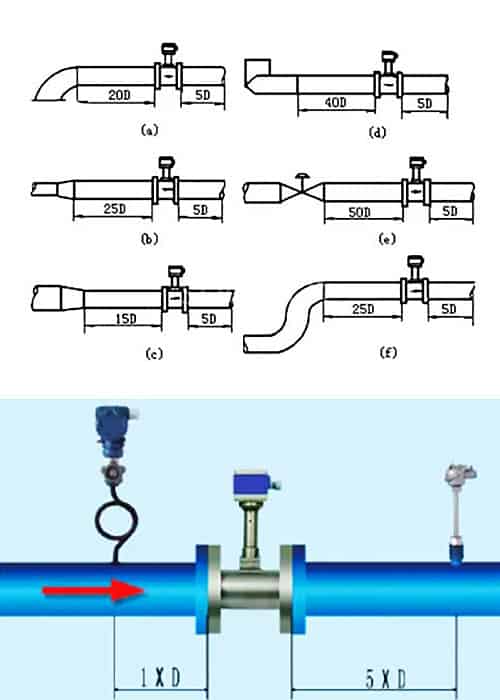
什么是上游流和下游流?
对于流体流动的 管道 ,在安装流量计时,首先必须了解上游流体和下游流体。
流体的入口方向为上游,出口方向为下游。
流量计的直管段是指流量计进水口(对应 上游管道) 和出水口(对应 下游管道) 所需的特定长度的直管段。也就是说,该段内的 上游管道 和 下游管道 必须是直的,不得有弯头、阀门或类似管件。通常, 上游管道 的长度要求会比 下游管道 的长度要求更长。
延伸阅读:流体流量计类型
10D上游和5D下游
用户使用孔板流量计时,通常要求孔板流量计前后直管段的上游管道直径为10D,下游管道直径为5D。那么,这个“D”代表什么呢?今天我将简要介绍一下。
“D”代表管道直径。对于孔板流量计中的孔板,上游管道和下游管道的最小要求分别为10D和5D。如果孔板前方有泵或调节阀,则直管段的要求会更高。
了解更多:如何计算管道压降?
不同流量计安装经验法则
由于孔板流量计自身结构的限制,其测量精度不高。安装过程中,多种系统因素都可能导致误差,且误差大小难以估算。
但通过分析导致误差的因素,可以降低误差。
孔板流量测量系统安装使用时,必须满足以下技术要求:
- 安装孔板时,孔板开口中心与管道中心轴线同心,且孔板端面垂直于管道轴线。
- 孔板上测压孔轴线与下游侧测压孔轴线之间的距离应满足25.4±0.8mm的要求。
- 孔板下游侧测压孔轴线应垂直于二维测量管内筒轴线。压力孔轴线与孔板两端外倾角之间的夹角不得大于3度。压力孔直径不得大于0.08D。
- 孔板安装需要前后直管段。直管段的长度与孔板上游侧局部阻力构件的形状和直径比β有关。其确定方法如下:
表. 孔板与节流阀之间所需的直管段长度(无流量调节器)
(数值以管径D的倍数表示)
| 直径比 β | 孔板上游侧(入口) | |||||||||||||
| 单90°弯头 | 同一平面内两个90°弯头,呈S形 | 垂直平面内两个90°弯头 | 同一平面内两个90°弯头 | 垂直平面内两个9°弯头,(5D>S) | 单90°三通 | 同一平面内两个45°弯头和一个单45°弯头,呈S形 (S>22D) | ||||||||
| 两个90°弯头 | (30D≥S>10D) | (30D≥S≥5D) | (30D≥S≥5D) | |||||||||||
| 任意平面 | ||||||||||||||
| (S>30D) | ||||||||||||||
| A | B | A | B | A | B | A | B | A | B | A | B | A | B | |
| 0.2 | 6 | 3 | 10 | 10 | 10 | 10 | 19 | 18 | 34 | 17 | 9 | 3 | 5 | 5 |
| 0.4 | 16 | 3 | 10 | 10 | 10 | 10 | 44 | 18 | 50 | 25 | 9 | 3 | 30 | 9 |
| 0.5 | 22 | 9 | 18 | 10 | 22 | 10 | 44 | 18 | 75 | 34 | 19 | 9 | 30 | 9 |
| 0.6 | 42 | 13 | 30 | 18 | 42 | 18 | 44 | 18 | 65 | 25 | 29 | 18 | 30 | 18 |
| 0.67 | 44 | 20 | 44 | 18 | 44 | 20 | 44 | 20 | 60 | 10 | 36 | 18 | 44 | 18 |
| 0.75 | 44 | 20 | 44 | 18 | 44 | 22 | 44 | 20 | 75 | 18 | 44 | 18 | 44 | 18 |
| 直径比 β | 孔板上游侧(入口) | 孔板下游侧(出口) | ||||||||||
| 变径管在 1.5D 至 3D 的长度范围内,直径由 2D 变为 D | 膨胀管在 D 至 2D 的长度范围内,直径由 0.5D 变为 D | 全通径球阀或闸阀完全打开 | 对称热缩管 | 温度计套筒或插座直径小于 0.03D | 所有前置节流阀类型和 密度计 套筒 | |||||||
| A | B | A | B | A | B | A | B | A | B | A | B | |
| 0.2 | 5 | 5 | 16 | 8 | 12 | 6 | 30 | 15 | 5 | 3 | 4 | 2 |
| 0.4 | 5 | 5 | 16 | 8 | 12 | 6 | 30 | 15 | 5 | 3 | 6 | 3 |
| 0.5 | 6 | 5 | 18 | 9 | 12 | 6 | 30 | 15 | 5 | 3 | 6 | 3 |
| 0.6 | 9 | 5 | 22 | 11 | 14 | 7 | 30 | 15 | 5 | 3 | 7 | 3.5 |
| 0.67 | 12 | 6 | 27 | 14 | 18 | 9 | 30 | 15 | 5 | 3 | 7 | 3.5 |
| 0.75 | 22 | 11 | 38 | 19 | 24 | 12 | 30 | 15 | 5 | 3 | 8 | 4 |
在严苛的安装条件下,孔板流量计应尽可能使用流量调节器。热电偶套管的安装不会改变其上游侧小直管段的长度。
小直管段的长度是指孔板上游挡板和下游挡板之间的距离。该长度的测量起点为相邻弯头或三通弯曲部分的下游端,或变径管和扩径管锥形部分的下游端。
扩展阅读:液态沥青/沥青流量计
差压式流量计所需的直管段长度为 10-62D,差异较大。这是因为所需的直管段长度取决于孔板的开度比(管道内径 D 与孔板内径 d 的比值 d/D)。
开度比(管道内径 D 与孔板内径 d 的比值 d/D)越大,所需的直管段越长。
反之,开度比越小,所需的直管段越短。
- 难以给出一个通用范围
- 建议在两侧使用脉冲管线
- 实际值取决于上游元件的类型和 β 比
- β 比定义为孔板直径除以管道直径
Discover more about: Differential Pressure Flow Meters
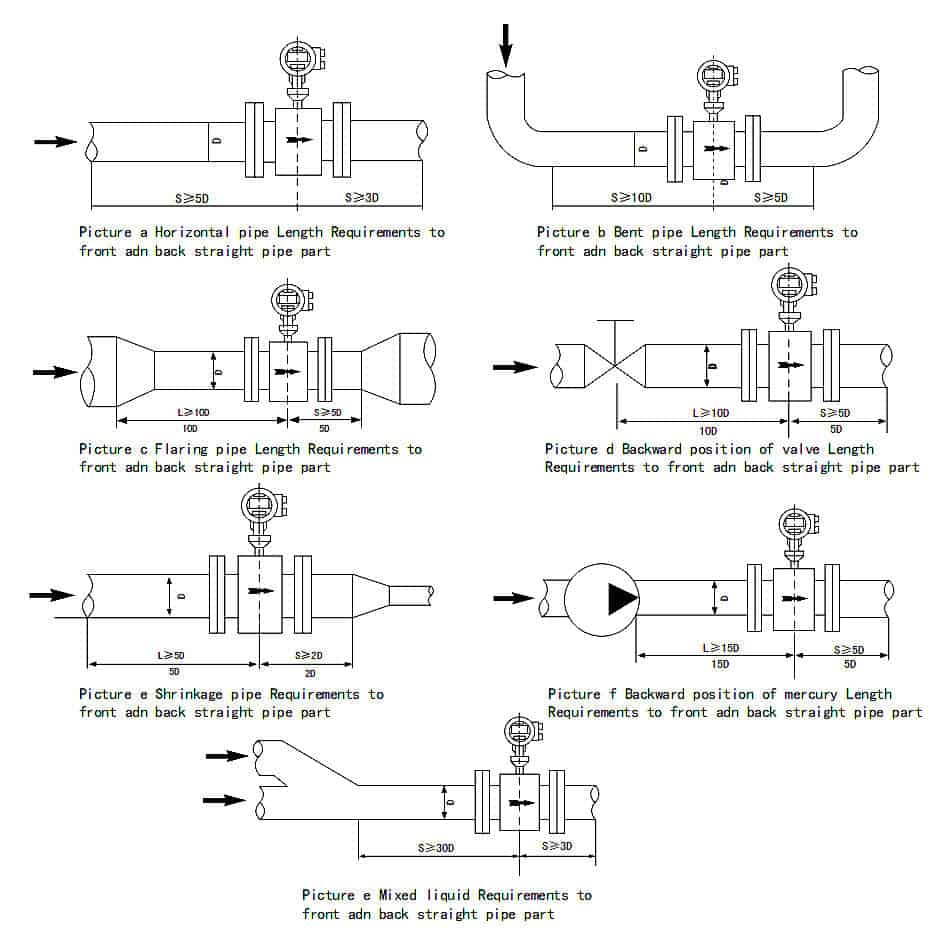
电磁流量计安装点的正确选择和传感器的正确安装都是非常重要的环节。
安装过程中哪怕出现微小的错误,都会影响测量精度;严重的错误则会影响传感器的使用寿命,甚至损坏传感器。
为了改善涡流和电流场畸变的影响,流量计前后直管段的长度有一定的要求,否则会影响测量精度。可以安装电源转换器,但必须避免安装在调节阀和半开阀附近或之后。
延伸阅读:电磁流量计的特殊安装情况
| 管道安装类型 | 安装说明图 | 标准管道类型 | |
| 前直管 L | 后直管 S | ||
| 弯管 | 图 a | 10D | 5D |
| 水平管道 | 图 b | 5D | 3D |
| 阀门后置 | 图 C | 10D | 5D |
| 扩口管 | 图 d | 10D | 5D |
| 水银后置 | 图 e | 15D | 2D |
| 收缩管 | 图 f | 5D | 2D |
| 混合液体 | 图 g | 30D | 3D |
延伸阅读:转子流量计和流量计有什么区别?
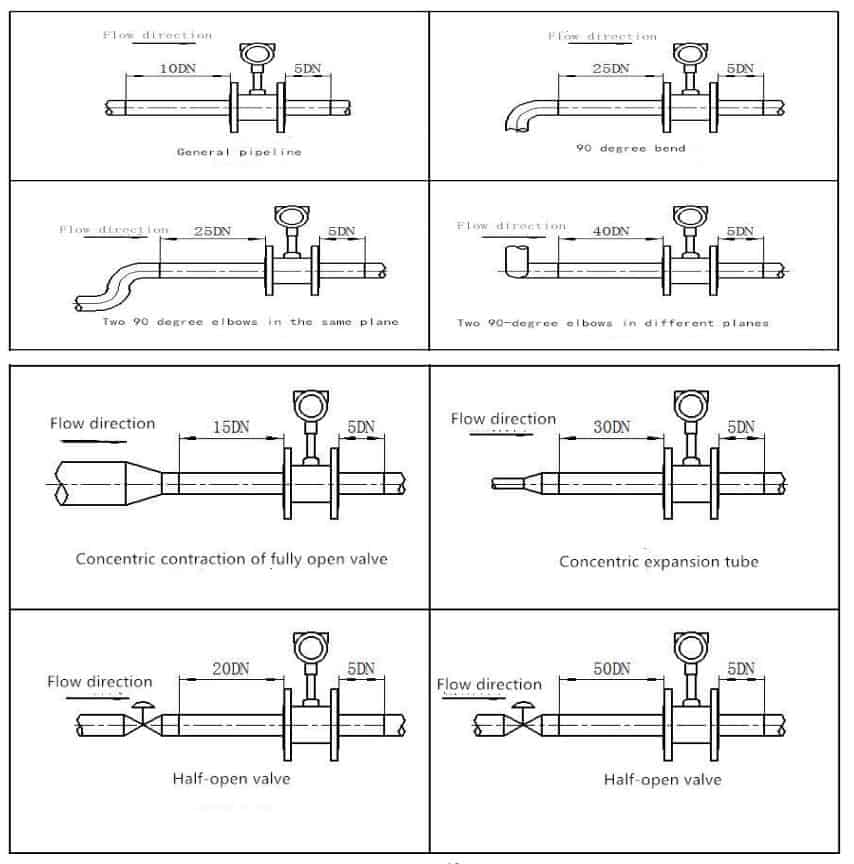
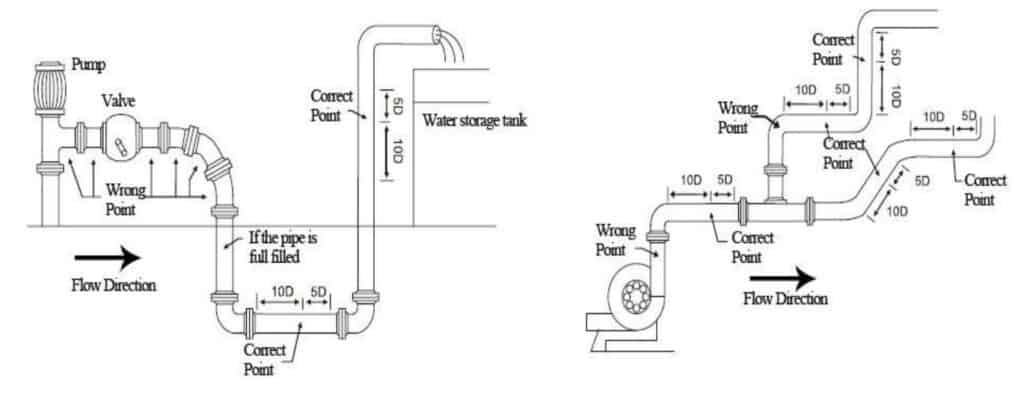
涡轮流量计安装的直管段要求非常重要,具体要求如下:
- 流量计对安装点上游和下游的直管段有一定的要求,否则会影响测量精度。
- 如果流量计安装点上游有变径管,则流量计上游应有一段等径不小于15D(D为管道直径)的直管段,下游应有一段等径不小于5D的直管段。
- 如果流量计安装点上游有渐扩管,则流量计上游应有一段等径不小于18D(D为管道直径)的直管段。下游应有一段直径不小于 5D 的等径直管段。
- 如果在流量计安装点上游有 90° 弯头或下行接头,则在流量计上游应有一段直径不小于 20D 的等径直管段,下游应有一段直径不小于 5D 的等径直管段。
- 如果在流量计安装点上游同一平面上存在 90° 弯头,则在流量计上游应有一段直径不小于 25D 的等径直管段,下游应有一段直径不小于 5D 的等径直管段。
椭圆齿轮流量计是一种专门用于测量高粘度介质流量的仪表。该仪表在工业领域发挥着非常重要的作用,测量精度也相对较高。
椭圆齿轮流量计在使用过程中无需使用直管段。
这种测量仪表可以方便地安装在阀门出口或管道转弯处,完全无需使用原有的直管段。这也是一种在安装过程中节省生产成本的巧妙方法。
椭圆齿轮流量计在安装前应进行清洗。如果液体中含有固体颗粒,则必须在管道上游安装过滤器;如果液体中含有气体,则应安装排气装置。
椭圆齿轮流量计对前后直管段没有特定要求,可以水平或垂直安装。安装时,流量计椭圆齿轮的旋转轴线应与地面平行。
延伸阅读:各种类型的质量流量计和体积流量计
了解更多:不同类型流量计——技术和应用分析
许多专业组织为大多数流量测量技术提供指导和标准,例如 ISA、ISO、API、AGA、ASME 和 ANSI。
如有疑问,建议您参考这些指南。这些指南经过测试,可为确保流量计正常工作提供良好的起点。
以下列出一些非常常见的指南/标准:
科里奥利流量计 – ISO10790
临界喷嘴流量计 – ISO9300
差压流量计 – ISO5167
电磁流量计 – ISO6817
容积式流量计 – ISO2714
热质量流量计 – ISO14511
涡轮流量计 – ISO2715
超声波流量计 – ISO17089
变面积流量计 – ISO11605
涡街流量计 – ISO/TR12764
ASME MFC-3M-2004
ASME MFC-6-2013
ASME MFC-11-2006
ASME MFC-5.1-2011
ASME MFC-16-2014
这些是确定适合您应用的流量计安装位置时需要考虑的一些通用指南。通过提出正确的问题,并充分了解现有的指导方针和标准,您应该能够充分利用在流量计方面的大量投资。
常见问题
相关流量计




相关博客

Sino-Inst 提供超过50种流量计,用于流量测量。其中约50%为 差压式 流量计,40%为液体流量传感器,20%为超声波 液位变送器 和质量流量计。
我们提供多种流量计样品供您选择,包括免费样品和付费样品。
如果您对流量计安装的上游和下游直管要求有任何疑问,请联系我们!
Sino-Instrument 是一家全球知名的流量测量仪器供应商和制造商,总部位于中国。
Request a Quote

吴鹏出生于1980年,是一位备受尊敬且成就卓著的男性工程师,在自动化领域拥有丰富的经验。凭借20多年的行业经验,吴鹏在学术和工程领域都做出了卓越的贡献。
在其职业生涯中,吴鹏参与了许多国内外工程项目。他最著名的项目包括炼油厂智能控制系统的开发、石化厂尖端分布式控制系统的设计以及天然气管道控制算法的优化。